PCB Trace Width Calculator
Calculate required trace width, resistance, voltage drop, power waste, and fusing threshold side by side using IPC-2221 and IPC-2152 standards.
Electrical & Thermal Auditing
Design Margin Width Breakdown
Saved Configurations Dashboard
| Name | Mode | Target | Layer | Copper | IPC-2221 | IPC-2152 | Resistance | V Drop | Loss | Fuse | Actions |
|---|---|---|---|---|---|---|---|---|---|---|---|
| No saved geometries. Click "Save Current Config" to log runs side-by-side. | |||||||||||
Given an operating voltage, determine the safe physical spacing boundaries (creepage and clearance distances) required between copper traces to avoid arcing based on IPC-2221 Section 6.3 specifications.
PCB Trace Width Calculator — IPC-2221 & IPC-2152
This free online PCB trace width calculator tells you the minimum copper trace width needed to carry your current without overheating — based on the industry-standard IPC-2221 and the modern IPC-2152 formulas, shown side by side. Also calculates trace resistance, voltage drop, power dissipation, and fusing current from a single set of inputs.
What Is PCB Trace Width and Why Does It Matter?
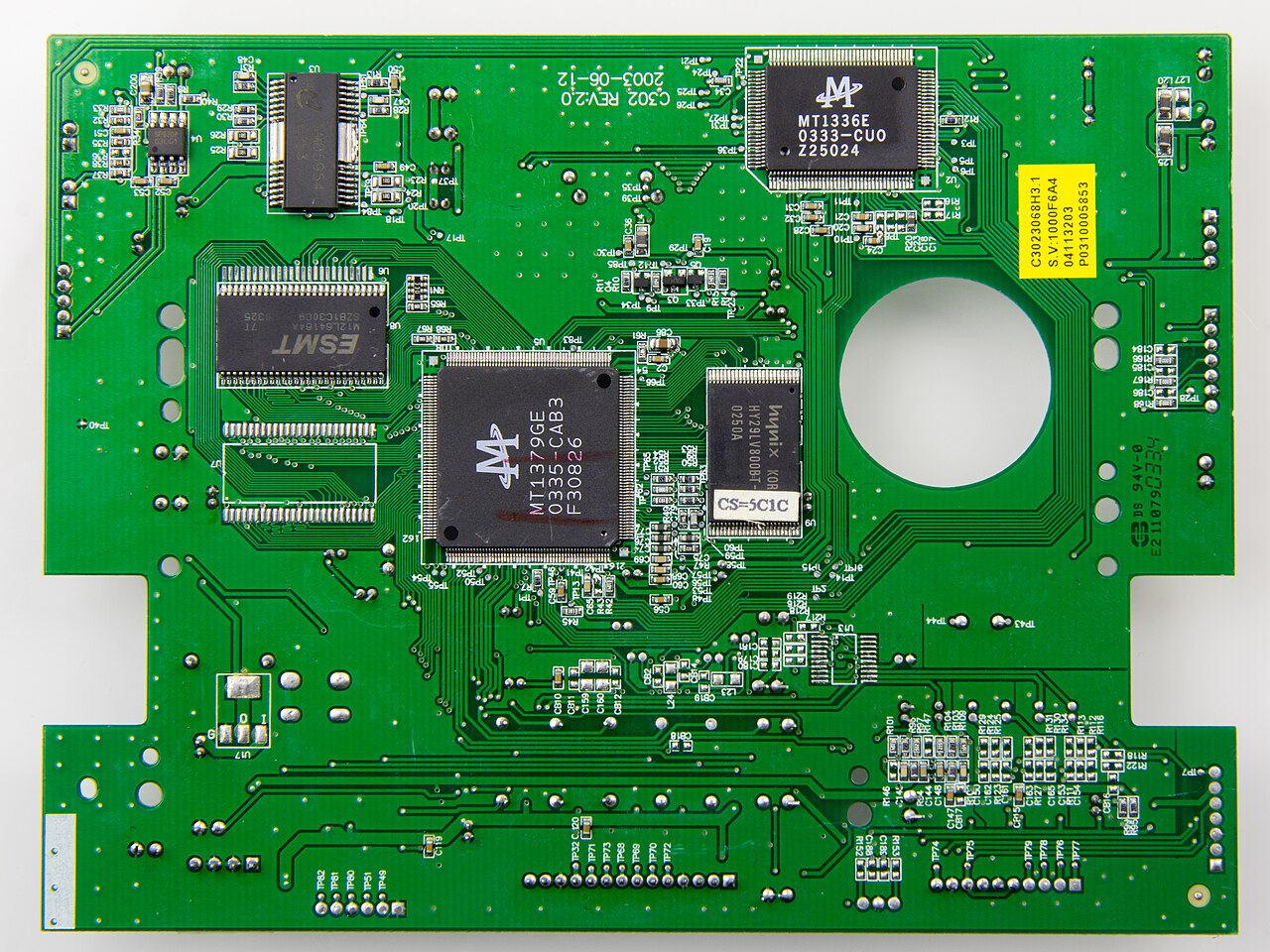
A PCB trace is a flat copper conductor etched onto a printed circuit board. Unlike a round wire in free air, a trace is a ribbon of copper bonded to an FR-4 fiberglass substrate — which means it has less surface area for heat dissipation and very different thermal behavior depending on which layer it sits on.
When current flows through a trace, resistive heating (I²R) raises the copper temperature. If the trace is too narrow for the current it carries, it can overheat, delaminate from the board, or burn open like a fuse — destroying your PCB. Getting trace width right is one of the most critical steps in PCB power design.
What This Calculator Computes
Minimum Trace Width — IPC-2221
The conservative industry standard. Based on empirical data from the 1950s,
IPC-2221 uses the formula I = k × ΔT^0.44 × A^0.725 with
k = 0.048 for external layers and k = 0.024 for internal layers.
It deliberately overestimates the required width, giving a safe margin
suitable for most commercial and consumer designs.
Minimum Trace Width — IPC-2152
The modern replacement standard (2009), based on updated test data with actual PCB substrates. IPC-2152 accounts for substrate thermal conductivity and copper plane proximity, producing more accurate — and typically narrower — required widths. Use this when board real estate is tight or when your design has significant copper pours nearby.
Trace DC Resistance — mΩ
Calculated from copper resistivity (1.72×10⁻⁸ Ω·m), trace length, width,
and copper thickness. Formula: R = (ρ × L) / (w × t).
Critical for power distribution network (PDN) analysis — even a few milliohms
of trace resistance causes measurable voltage drops on 3.3V and 5V rails.
Voltage Drop — mV
V_drop = I × R. The voltage lost across the trace length
due to its resistance. For a 5V, 2A power rail, even a 100mΩ trace
resistance causes a 200mV drop — 4% of the rail voltage. Sensitive
analog circuits, ADCs, and memory chips often require drops below 50mV.
Power Dissipation — mW
P = I² × R. The heat generated by the trace itself.
This feeds back into the thermal model — high power dissipation in
a trace means even more heating, which is why IPC formulas are
iterative. Also useful for thermal budget calculations in
enclosed designs.
Fusing Current — Amps
The current at which the trace will melt open, calculated using
Preece's formula: I_fuse = 80 × d^1.5
(adapted for PCB traces). Some designers intentionally use
undersized traces as PCB fuses for overcurrent protection —
this output tells you exactly where that threshold is for your geometry.
Reverse Mode — Width to Current
Already have a trace width and need to know the maximum safe current? The reverse calculator flips the IPC-2221 formula: enter your trace width, copper weight, and allowable temperature rise, and get the maximum current capacity in amps. This is the most common real-world use case when reviewing existing designs.
Safety Margin Applied Width
The IPC minimum is a theoretical threshold — good engineering practice adds a margin. The tool shows widths at 1.0× (bare minimum), 1.25× (recommended for most designs), 1.5× (conservative), and 2.0× (high-reliability / automotive / medical) so you can pick the right margin for your application.
IPC-2221 vs IPC-2152 — Which Should You Use?
| Property | IPC-2221 | IPC-2152 |
|---|---|---|
| Data Source | 1950s empirical tests | 2009 modern measurements |
| Result | Conservative (wider traces) | More accurate (narrower traces) |
| k (external) | 0.048 | ~0.089 |
| k (internal) | 0.024 | ~0.048 (substrate-corrected) |
| Accounts for ground planes? | No | Yes |
| Industry acceptance | Universal | Growing, required in some industries |
| Best for | General commercial, hobbyist | Space-constrained, high-density PCBs |
| Risk level | Safe (over-specifies) | Accurate but requires more care |
Recommendation: Use IPC-2221 as your baseline and IPC-2152 as a secondary check. If both agree within 20%, you have a robust design. If IPC-2152 gives a significantly narrower trace, consider whether your board has the copper pours and ground planes that justify the tighter spec.
The IPC-2221 Formula Explained
I = k × ΔT^0.44 × A^0.725
Rearranged for width: W = A / t where A = (I / (k × ΔT^0.44))^(1/0.725)
| Parameter | Symbol | External Layer | Internal Layer |
|---|---|---|---|
| Current (Amps) | I | User input | |
| Temperature Rise (°C) | ΔT | User input (10–100°C) | |
| Cross-section (mil²) | A | Calculated (W × thickness) | |
| IPC constant | k | 0.048 | 0.024 |
| Copper: 0.5 oz | t | 0.685 mil (17.5 µm) | |
| Copper: 1 oz | t | 1.37 mil (35 µm) | |
| Copper: 2 oz | t | 2.74 mil (70 µm) | |
| Copper: 3 oz | t | 4.11 mil (105 µm) | |
Practical Trace Width Reference
| Application | Typical Current | Recommended Width (1oz, Ext.) | ΔT Target |
|---|---|---|---|
| Digital signal trace (SPI, I²C) | < 0.1A | 4–6 mil (std DRC) | Any |
| USB 2.0 power (500mA) | 0.5A | 8 mil (0.2mm) | 10°C |
| USB-C power (3A) | 3A | 50 mil (1.27mm) | 10°C |
| 5V microcontroller rail (1A) | 1A | 15 mil (0.38mm) | 10°C |
| Motor driver output (5A) | 5A | 120 mil (3mm) or pour | 20°C |
| 12V automotive (10A) | 10A | Use polygon pour + 2oz | 20°C |
| Battery charge trace (2A) | 2A | 30 mil (0.76mm) | 10°C |
| LED strip power (3A) | 3A | 50 mil (1.27mm) | 20°C |
Design Rules of Thumb
Sizing Guidelines
- Always apply at least a 25% margin over the IPC-2221 minimum
- For power traces above 3A, consider polygon pours instead of single traces
- Use 2oz copper for high-current layers — doubles thickness, halves resistance
- Internal power planes carry current better than internal signal traces
- Short traces can be narrower — resistance and heating scale with length
- Traces feeding connectors should be sized for the connector's max current rating
Temperature Budget
- Use 10°C rise for precision analog, RF, and memory circuits
- Use 20°C rise for general digital and mixed-signal
- Use 40°C rise only for short, non-critical power connections
- Total trace temperature = ambient + rise. Keep below 85°C for consumer products
- Automotive and industrial: keep total below 125°C (junction limit of most ICs)
- Add thermal reliefs on component pads to prevent pad lifting during soldering
Video: How Wide Should PCB Traces Be?
This clear, practical tutorial walks through the IPC-2221 standard, explains why trace width matters for current capacity, and shows real examples of correctly and incorrectly sized power traces — directly relevant to using this calculator.
📺 PCB Basics: How WIDE Should Traces Be? (IPC-2221 Circuit Design Specs). Covers the IPC-2221 formula, internal vs external layers, copper weight, and real design examples — perfect context for understanding the calculator results above.
Frequently Asked Questions — PCB Trace Width
The most common questions engineers and students have about PCB trace sizing, IPC standards, and current capacity.
Basics
How wide should a PCB trace be for 1 amp?
For 1A on an external layer with 1oz copper and a 10°C temperature rise, IPC-2221 gives approximately 15 mils (0.38mm). For an internal layer, the same current requires approximately 28 mils (0.71mm). Always add 25% margin — so use 20 mil external or 35 mil internal in practice.
What temperature rise should I design for?
For most designs, 10°C rise is the safe default. It gives you headroom for ambient temperature variation and component heat nearby. For non-critical power traces inside a well-ventilated enclosure, 20–30°C is acceptable. Never design to the maximum (100°C) — that is the fusing limit, not a safe operating point.
What is 1 oz copper and how does it affect trace width?
1 oz copper = 1.37 mils (35 µm) thick. Thicker copper means a larger cross-section for the same width, so it carries more current. A 2oz trace is twice as thick — you can use a narrower width for the same current capacity. Most fabricators default to 1oz. Specify 2oz when routing traces above 3–5A.
Why does an internal trace need to be wider?
External traces dissipate heat by convection into air (good conductor). Internal traces are surrounded by FR-4 fiberglass on all sides, which is a very poor thermal conductor. Heat builds up faster, requiring approximately twice the width for the same current and temperature rise.
Should I use a polygon pour instead of a wide trace?
For currents above 5–8A, a copper pour (polygon fill) is strongly recommended over a single wide trace. Pours spread heat over a larger area, reduce resistance dramatically, and are more mechanically robust. Most PCB CAD tools (KiCad, Altium, EasyEDA) support polygon pours with a single click.
Standards & Calculations
What is the difference between IPC-2221 and IPC-2152?
IPC-2221 uses 1950s empirical data and is conservative — it ignores the cooling effect of nearby copper pours and ground planes. IPC-2152 (2009) uses modern measurements and accounts for substrate and plane effects, giving more accurate and typically less conservative widths. Both are accepted industry standards; IPC-2221 remains more commonly specified in commercial designs.
How do I calculate trace resistance?
R = (ρ × L) / (W × t) where ρ = 1.72×10⁻⁸ Ω·m,
L = trace length (m), W = width (m), t = copper thickness (m).
Example: a 100mm long, 10 mil wide, 1oz trace has R ≈ 49 mΩ.
At 1A, that is a 49mV voltage drop and 49mW of heat.
What is fusing current for a PCB trace?
The fusing current is the point at which the trace overheats so severely that the copper melts and opens the circuit — acting like a fuse. Calculated by Preece's formula. For a 10 mil, 1oz trace, the fusing current is approximately 7–9A. Some engineers deliberately size traces to fuse at a specific overcurrent level as a low-cost protection mechanism.
How much voltage drop is acceptable on a power rail?
General rule: keep voltage drop below 3% of the rail voltage. For a 3.3V rail, that is 99mV maximum. For a 5V rail, 150mV. For sensitive analog or RF circuits, target under 1% (33mV on 3.3V). Use the trace resistance and voltage drop outputs from this calculator to verify your rail routing before fabrication.
Does the PCB substrate material affect trace width calculations?
IPC-2221 assumes standard FR-4 and does not account for substrate thermal conductivity directly. IPC-2152 does model substrate effects. For high-frequency or high-temperature substrates (Rogers 4003, polyimide, ceramic), the thermal behavior differs — use IPC-2152 with caution and consider a full thermal simulation for critical designs.
Do I need to account for ambient temperature?
Yes. IPC-2221 calculates temperature rise above ambient, not absolute temperature. If your board sits in a 60°C enclosure and you allow a 20°C rise, the trace reaches 80°C — which is fine for FR-4 (Tg ~130°C) but may stress nearby components. Always add ambient temperature to the calculated rise when checking against component operating limits.
Advanced PCB Trace Design Concepts
The Real Thermal Model
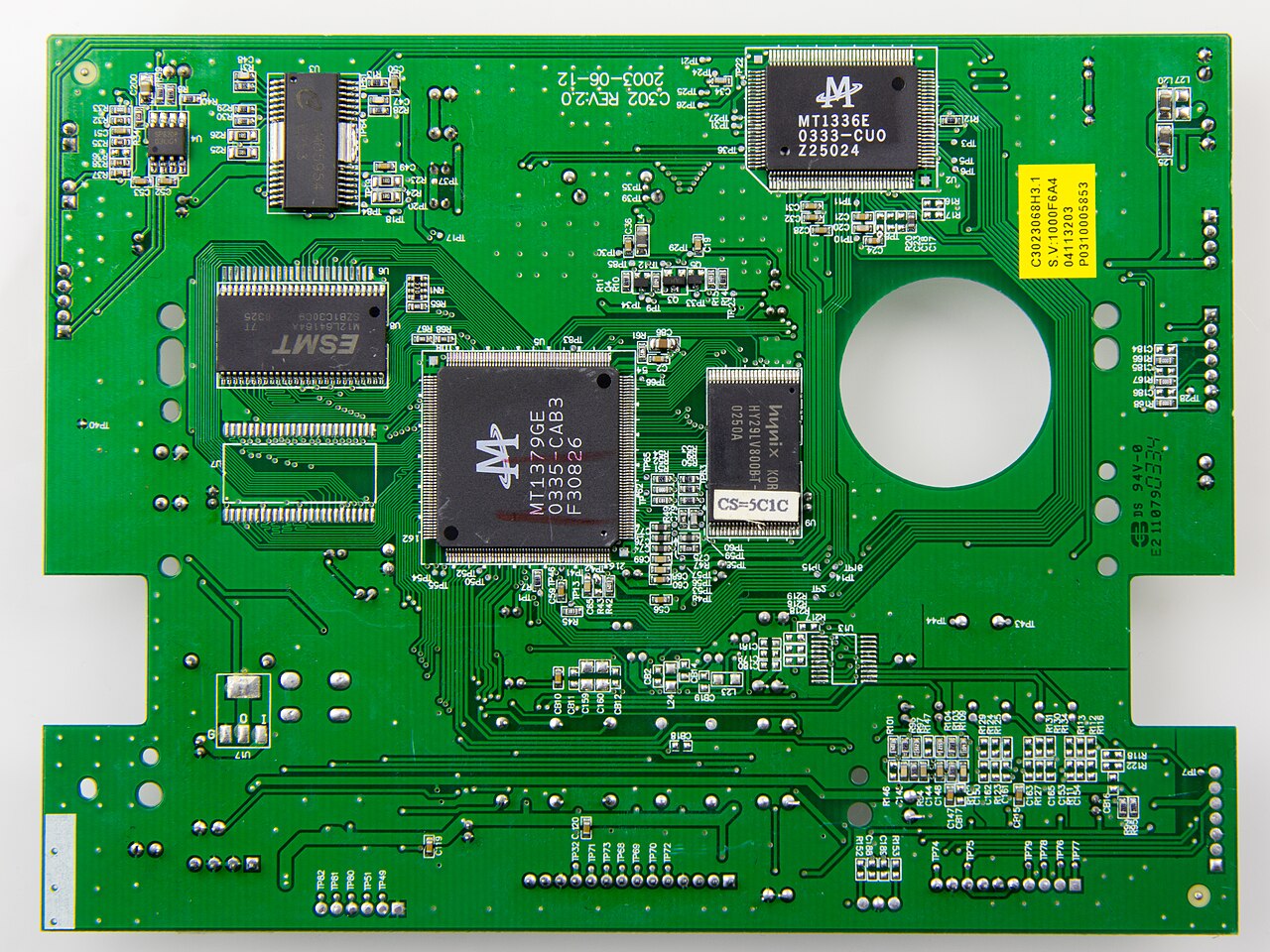
IPC-2221 treats each trace in isolation. A real PCB is a thermal network: nearby copper pours act as heat spreaders, vias conduct heat between layers, and component packages add heat sources. In practice, a trace near a large copper pour runs significantly cooler than IPC-2221 predicts — which is exactly why IPC-2152 was developed. For critical power designs, the only reliable verification is a 3D thermal simulation with your actual stack-up and component placement.
Using Traces as PCB Fuses
A deliberate application of the fusing current calculation: route a short, narrow trace in series with a protected circuit at a width calculated to fuse at slightly above the maximum expected operating current. This provides low-cost overcurrent protection without a discrete fuse component. Limitations: PCB fuses are single-use (the board is destroyed on trip), imprecise (±30–50%), and may spray vaporized copper. Use only for non-critical applications where discrete fuses cannot fit.
High Current Design — When to Use Polygon Pours
Above about 5A, single-trace routing becomes impractical — a 5A, 1oz external trace at 10°C rise requires ~120 mil (3mm), which is very wide and inflexible for routing. The professional solution is a copper polygon pour that floods an entire region. This gives effectively unlimited current capacity limited only by the via connections entering and leaving the pour. For motor drivers, battery management, and power conversion circuits, polygon pours on a dedicated layer are standard practice.
Skin Effect at High Frequencies
IPC-2221 and IPC-2152 are DC models. At AC frequencies above ~100kHz, the skin effect concentrates current at the outer surface of the trace, increasing effective resistance above the DC value. At 1MHz in a 1oz copper trace, the skin depth is ~66µm — comparable to the trace thickness. At 100MHz, it drops to ~6.6µm, meaning only the outermost skin of the copper carries current. For RF power traces, always consult skin depth calculations and use our Skin Depth Calculator alongside this tool.
Related Free Tools on CircuitsLab Wiki
- PCB Via Current Calculator — Current capacity and thermal rise for PCB vias
- Planar Inductor Calculator — Spiral coil inductance, Q-factor & DCR for PCB coils
- Skin Depth Calculator — AC resistance in copper at any frequency
- LM317 Regulator Calculator — Output voltage and resistor sizing
- LED Series Resistor Calculator — Safe current limiting for LEDs
- Buck Converter Designer — Inductor and capacitor sizing for DC-DC converters