555 Timer Calculator
Calculate frequency, period, duty cycle, high time, and low time for the NE555 in astable mode — or pulse width for monostable one-shot circuits. Includes reverse calculator, 50% duty cycle mod, and standard resistor suggestions. Works for NE555, LM555, and LMC555 CMOS variants.
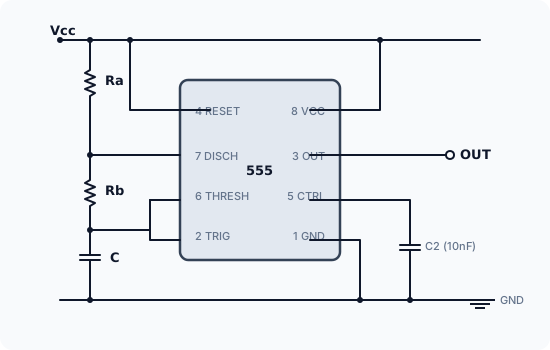
The 555 Timer — Most Sold IC in History
Designed by Hans Camenzind for Signetics in 1971 and released as the SE555/NE555, the 555 timer is not just historically significant — it is still actively designed into new products today. Its combination of precision timing, high output current (enough to drive LEDs and small relays directly), wide supply voltage range, and rock-bottom cost makes it irreplaceable in cost-sensitive designs. Over one billion are manufactured annually across dozens of variants from TI, ON Semi, STMicroelectronics, and others.
The Three Operating Modes
① Astable
Free-running oscillator. Output switches between high and low continuously with no external trigger. Frequency and duty cycle set by Ra, Rb, and C.
② Monostable
One-shot timer. Triggered by a falling edge on pin 2. Output goes high for a precise duration T then returns low. Pulse width set by R and C.
③ Bistable
SR flip-flop mode. Pin 2 (trigger) sets output high; pin 4 (reset) pulls it low. Output holds its state indefinitely — no timing components needed.
Astable Mode — How It Works
In astable mode, the 555 timer acts as a relaxation oscillator. The capacitor C alternately charges through Ra + Rb (output high) and discharges through Rb alone (output low). Two internal comparators watch the capacitor voltage — when it crosses 2/3 Vcc the output goes low and discharge begins; when it falls to 1/3 Vcc the output goes high and charging restarts. This cycle repeats indefinitely.
Astable Formulas
FREQUENCY
f = 1.44 ÷ ((Ra + 2Rb) × C)
PERIOD
T = 0.693 × (Ra + 2Rb) × C
DUTY CYCLE
D = (Ra + Rb) ÷ (Ra + 2Rb)
HIGH / LOW TIME
Thigh = 0.693 × (Ra + Rb) × C
Tlow = 0.693 × Rb × C
Ra and Rb in ohms (Ω) · C in farads (F) · Use 10nF–10µF for audio/timing range
Monostable Mode — How It Works
In monostable mode, the 555 normally sits with output low and the capacitor discharged. When a negative pulse (falling edge) hits pin 2 (Trigger), the output instantly goes high and the capacitor begins charging through R toward Vcc. When it reaches 2/3 Vcc, the comparator fires, the output returns low, and the capacitor is discharged back to zero — ready for the next trigger. The output stays high for exactly T = 1.1 × R × C regardless of how long the trigger is held.
Monostable Formula
T = 1.1 × R × C
T = output pulse width in seconds · R in ohms (Ω) · C in farads (F)
555 Timer Pin Reference
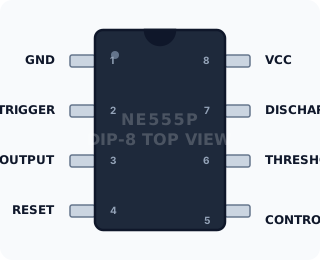
| Pin | Name | Function | Typical Connection |
|---|---|---|---|
| 1 | GND | Negative supply | Ground (0V) |
| 2 | TRIGGER | Starts monostable pulse when pulled below 1/3 Vcc | Switch to GND (monostable) / Capacitor junction (astable) |
| 3 | OUTPUT | Digital output — high or low | Load, LED via resistor, speaker |
| 4 | RESET | Active-low reset — forces output low immediately | Connect to Vcc to disable reset |
| 5 | CONTROL VOLTAGE | Overrides internal 2/3 Vcc threshold | 10nF cap to GND (unused) or signal for FM mod |
| 6 | THRESHOLD | Resets flip-flop when voltage crosses 2/3 Vcc | Top of capacitor |
| 7 | DISCHARGE | Open-collector transistor — discharges capacitor | Junction of Ra and Rb (astable) |
| 8 | Vcc | Positive supply | 5–15V (NE555) or 1.5–15V (LMC555) |
Worked Design Examples
Example 1 — 1Hz LED Flasher
Target: f = 1Hz, duty cycle ≈ 50%
- Choose C = 10µF (electrolytic)
- For 1Hz: Ra + 2Rb = 1.44 / (1 × 0.00001) = 144,000Ω
- For near-50% duty: make Ra small → Ra = 1kΩ, Rb = 71.5kΩ
- Use standard values: Ra = 1kΩ, Rb = 68kΩ
- Actual f = 1.44 / (137000 × 0.00001) = 1.05 Hz ✓
- Duty = (1k + 68k) / (1k + 136k) = 50.4%
Example 2 — 500ms Door Buzzer
Target: one beep of exactly 0.5 seconds
- Monostable mode: T = 1.1 × R × C = 0.5s
- Choose C = 10µF
- R = 0.5 / (1.1 × 0.00001) = 45,454Ω
- Use standard value: R = 47kΩ
- Actual T = 1.1 × 47000 × 0.00001 = 0.517s ✓
- Trigger with a doorbell button on pin 2 (active low)
NE555 vs LMC555 — Which to Use?
The NE555 (bipolar) remains the default for most designs: rugged, cheap, tolerant of supply noise, and capable of sourcing or sinking up to 200mA — enough to drive a small relay or buzzer directly. Its weakness is a 6mA quiescent current and voltage spikes on the supply line when the output switches. Always decouple pin 8 with a 10µF electrolytic and a 100nF ceramic in parallel.
The LMC555 (CMOS) draws under 100µA — 60× less than NE555. It works down to 1.5V supply, produces no switching spikes, and has rail-to-rail output. Use it in any battery-powered design or wherever the NE555's supply noise would be a problem.
The 50% Duty Cycle Modification
Standard astable duty cycle is always above 50% because the high time charges through both Ra and Rb while the low time discharges through Rb alone. The classic fix: add a 1N4148 diode in parallel with Rb, cathode toward pin 7.
With the diode, charging current bypasses Rb entirely and flows through Ra only. Discharging still goes through Rb. The new formulas become:
Tlow = 0.693 × Rb × C (discharges through Rb only)
Duty = Ra ÷ (Ra + Rb) (set Ra = Rb for exactly 50%)
Practical Applications
| Application | Mode | Typical Values | Notes |
|---|---|---|---|
| LED Flasher (1Hz) | Astable | Ra=1kΩ, Rb=68kΩ, C=10µF | Add 470Ω series resistor to LED on pin 3 |
| Tone Generator (1kHz) | Astable | Ra=1kΩ, Rb=10kΩ, C=47nF | Connect 8Ω speaker via 100µF blocking cap |
| PWM Motor Controller | Astable | f=5–20kHz, variable duty via pot | Replace Rb with potentiometer for variable speed |
| Switch Debouncer | Monostable | R=47kΩ, C=10µF → T=0.5s | Output re-triggers only after T expires |
| Missing Pulse Detector | Monostable | T slightly longer than expected pulse period | Output goes low if input pulse fails to arrive |
| Atari Punk Console | Dual Astable | Two 555s or one 556 dual timer | First 555 clocks second; both controlled by pots |
| Clock for Digital Logic | Astable | f=1–100Hz for visible logic states | Use CMOS 555 to avoid noise coupling into logic |
| Servo Signal Generator | Astable/Monostable | f=50Hz, Th=1–2ms | Requires diode mod for correct pulse width |
Video: 555 Timer IC — Astable & Monostable Explained
GreatScott's Electronics Basics #26 covers the 555 timer with real breadboard circuits for both astable and monostable modes, showing exactly how the capacitor charges and discharges and how to calculate the component values. Practical, clear, and under 10 minutes — ideal before using this calculator for the first time.
Frequently Asked Questions — 555 Timer
How do I calculate 555 timer frequency?
Use f = 1.44 ÷ ((Ra + 2Rb) × C) with Ra and Rb in ohms
and C in farads. For example: Ra = 1kΩ, Rb = 10kΩ, C = 100nF →
f = 1.44 ÷ (21000 × 0.0000001) = 685 Hz.
What is the monostable formula?
T = 1.1 × R × C. For a 1-second delay:
choose C = 10µF and R = 0.1 ÷ (1.1 × 0.00001) ≈ 91kΩ.
Use the nearest E24 standard value of 91kΩ.
Can I get 50% duty cycle?
Yes, with a diode across Rb (cathode to pin 7). Charging now goes through Ra only; discharging through Rb only. Set Ra = Rb for exactly 50%. Without the diode, duty cycle is always above 50%.
NE555 vs LMC555 — which do I pick?
NE555 (bipolar): 5–15V, up to 200mA output, higher current draw (~6mA). Best for hobby and general circuits. LMC555 (CMOS): 1.5–15V, under 0.1mA, rail-to-rail output, no switching spikes. Best for battery-powered or noise-sensitive designs.
What is Pin 5 (Control Voltage) for?
Pin 5 accesses the internal voltage divider, normally at 2/3 Vcc. If unused, connect a 10nF capacitor to ground to reject noise. Applying a voltage to pin 5 shifts the threshold and changes the output frequency — enabling FM (frequency modulation).
Why is my 555 timer frequency wrong?
Common causes: (1) Capacitor entered in wrong unit — 100nF ≠ 100µF. (2) Electrolytic capacitors have ±20% tolerance — use film or ceramic for accuracy. (3) Resistor tolerance — use 1% metal film. (4) Supply voltage variation affects NE555 timing slightly.
What is the highest frequency a 555 can produce?
NE555 maximum reliable frequency is around 500kHz. Theoretical maximum is ~1MHz but output waveform quality degrades above 500kHz. The LMC555 can operate cleanly to 3MHz. For higher frequencies, use a dedicated oscillator IC or a crystal oscillator.
Why does my 555 need a decoupling capacitor?
The NE555's output stage switches up to 200mA instantly, causing a voltage spike on the supply rail that can reset nearby microcontrollers or corrupt sensor readings. Place a 100nF ceramic and 10µF electrolytic from pin 8 to pin 1, as close to the IC as possible. Never omit this — it is not optional.
Advanced 555 Techniques
Voltage-Controlled Oscillator (VCO)
Apply a control voltage (0.5V to Vcc) to pin 5 to build a VCO. The output frequency varies with the control voltage — this is the basis of FM synthesis in vintage synthesizers like the Atari Punk Console. The relationship is nonlinear but predictable: higher control voltage → lower frequency (higher threshold = capacitor takes longer to reach it).
556 Dual Timer
The 556 IC is two independent 555 timers in a single 14-pin DIP package. Classic use: chain the monostable output of the first timer into the trigger of the second for cascaded timing sequences. The Atari Punk Console uses a 556 as two astable oscillators — one clocking the other — to produce its characteristic stepped-tone sound.
Preventing False Triggering
In monostable mode, if the trigger input (pin 2) is left floating or connected to a noisy signal, the timer can fire on its own. Always connect a pull-up resistor (10kΩ to Vcc) on pin 2 and add a 100nF capacitor to ground on pin 5. In high-noise environments, add an RC filter on pin 2: 1kΩ series + 100nF to ground before the pin.
Long Time Delays — Practical Limits
The theoretical maximum delay with T = 1.1RC is hours, but electrolytic capacitor leakage current flows through the timing resistor and adds an effective parallel resistance, shortening the actual delay. For delays over 10 seconds, use a CMOS 555 (lower leakage) with a film capacitor and high-value resistor, or cascade two monostable stages. For delays over 1 minute, use a microcontroller — it is more accurate.
Related Tools on CircuitsLab Wiki
- RC Filter Calculator — Cutoff frequency and time constant — the same RC charging principle the 555 uses internally
- Op-Amp Gain Calculator — Pair with a 555 for precision comparator-based timing circuits
- LED Resistor Calculator — Size the series resistor for the LED driven by your 555 output
- Voltage Divider Calculator — Design the control voltage network for Pin 5 VCO applications
- Digital Logic Simulator — Simulate the logic gates and flip-flops inside the 555 timer
- Audio Crossover Calculator — Filter the output of a 555 tone generator